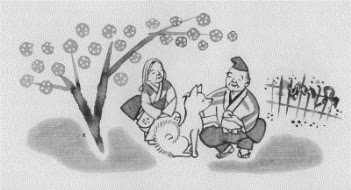
 ONCE upon a time there was a very kind old man and his wife living in a certain village. Next door to them lived a very mean old man and his wife. The kind old couple had a little white dog named Shiro. They loved Shiro very much and always gave him good things to eat. But the mean old man hated dogs, and every time he saw Shiro he threw stones at him.

One day Shiro began barking very loudly out in the farmyard. The kind old man went out to see what the matter was. Shiro kept barking and barking and began digging in the ground.
"Oh, you want me to help you dig?" asked the old man. So he brought a spade and began digging. Suddenly his spade hit something hard. He kept digging and found a large pot full of many pieces of gold money. Then he thanked I Shiro very much for leading him to so much gold, and took the money to his house.
Now the mean old man had been peeping and had seen all this. He wanted some gold too. So the next day he asked the kind old man if he could borrow Shiro for a little while. "Why, of course you may borrow Shiro, if he'll be of any help to you," said the kind old man.
The mean old man took Shiro to his house and out into his field.
"Now find me some gold too," he ordered the dog, "or I'll beat you." So Shiro began digging at a certain spot. Then the mean old man tied Shiro up and began digging himself. But all he found in the hole was some terrible smelling garbage-no gold at all. This made him so angry that he hit Shiro over the head with his spade, and killed him.
The kind old man and woman were very sad about Shiro. They buried him in their field and planted a little pine tree over his grave. And every day they went to Shiro’s grave and watered the pine tree very carefully. The tree began to grow very fast, and in only few years it became very big. The kind old woman said: "Remember how Shiro used to love to eat rice-cakes? Let's cut down that big pine tree and make a mortar. Then with the mortar we'll make some rice-cakes in memory of Shiro."
So the old man cut down the tree and made a mortar out of its trunk.
Then they filled it full of steamed rice and began pounding the rice to make rice-cakes. But no sooner did the old man begin pounding than all the rice turned into gold! Now the kind old man and woman were richer than ever.
The mean old man had been peeping through the window and had seen the rice turn to gold. He still wanted some gold for himself very badly. So the next day he came and asked if he could borrow the mortar. "Why, of course you may borrow the mortar," said the kind old man.
The mean old man took the mortar home and filled it full of steamed rice. "Now watch," he said to his wife. "When I begin pounding this rice, it'll turn to gold." But when he began pounding, the rice turned to terrible smelling garbage, and there was no gold at all. This made him so angry that he got his ax and cut the mortar up into small pieces and burned it up in the stove.
When the kind old man went to get his mortar back, it was all burned to ashes. He was very sad, because the mortar had reminded him of Shiro. So he asked for some of the ashes and took them home with him.
It was the middle of winter and all the trees were bare. He thought he'd scatter some of the ashes around in his garden. When he did, all the cherry trees in the garden suddenly began to bloom right in the middle of winter. Everybody came to see this wonderful sight, and the prince who lived in a nearby castle heard about it.
 Now this prince had a cherry tree in his garden that he loved very much. He could hardly wait for spring to come so he could see the beautiful blossoms on this cherry tree. But when spring came he discovered that the tree was dead and he felt very sad. So he sent for the kind old man and asked him to bring the tree back to life. The old man took some of the ashes and climbed the tree. Then he threw the ashes up into the dead branches, and almost more quickly than you can think, the tree was covered with the most beautiful blossoms it had ever had.
The prince had come on horseback to watch and he was very pleased.
He gave the kind old man a great deal of gold and many presents. And, best of all, he knighted the old man and  gave him a new name, "Sir Old-Man-Who-Makes-Trees-Blossom."
Sir Old-Man-Who-Makes-Trees-Blossom and his wife were now very rich, and they lived very happily for many more years.
Vocabulary
Mean (Adj.) : unkind or unpleasant
Throw (V) : to send something through the air with force, especially by a sudden movement of the arm.
 Bark (V) : (of a dog) to make a loud rough noise
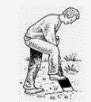
Dig (V) : to break up and move soil using a tool, a machine or your hands
Spade (N) : a tool used for digging especially
soil or sand, with a long handle and a flat blade. (Shovel, Scoop).
Peep (V) : to secretly look at something for a short time, usually through a hole.
Tie up (V) : fasten or to fasten something together using string, rope or something similar
Mortar (N) : a hard strong bowl in which substances are crushed into a powder by hitting or rubbing them with a pestle (= heavy tool).
Pounding : repeated and heavy striking or hitting of someone or something
Scatter (V) : to cover a surface with things that
are far apart and in no particular
arrangement.
Knighted (V) : to give someone the rank of knight.
Source : japannipon.com


